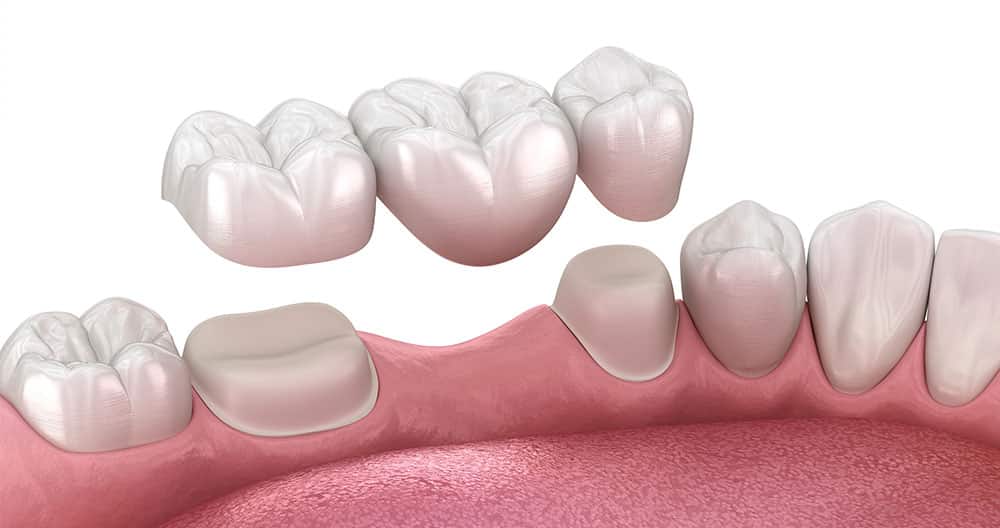
A dental bridge replaces one or more missing teeth by joining a false tooth to the teeth on either side of the gap. It is fixed in place, so it does not come out like a denture. At BWG Dental Centre in Bradford, Dr. Rebeca Riojas-Ozturk, our general and family dentist, makes bridges for patients who have lost a tooth to decay, infection, gum disease or an injury.
Below you can read how a bridge works, which type might suit you, how it compares with other ways to fill a gap, and how to keep it clean.
How does a dental bridge work?
A bridge has two kinds of parts.
- Abutments. These are crowns that fit over the teeth next to the gap, or onto implants. They hold the bridge in place.
- Pontics. These are the false teeth that sit in the gap. They rest on the gum and are joined to the abutments.
The whole bridge is made as one piece in a dental laboratory and then cemented in place. From the outside it looks like a row of teeth.
Why replace a missing tooth at all?
Some people manage for years with a gap, especially near the back. Others notice problems over time. A gap can affect you in a few ways:
- Shifting teeth. The teeth beside the gap can tilt into it, and the tooth above or below can drift down or up.
- Chewing. Losing a back tooth can push more of the work onto the other side of your mouth.
- Speech. A missing front tooth can change how some words sound.
- Appearance. A visible gap can make people self-conscious about smiling.
Whether to replace a tooth, and how, is your decision. Your dentist can tell you what is likely to happen in your mouth if the gap is left.
What types of bridge are there?
Traditional bridge
The most common design. The teeth on both sides of the gap are prepared for crowns, and the false tooth sits between them. It suits a gap with healthy teeth on each side.
Cantilever bridge
Used when there is a suitable tooth on only one side of the gap. The false tooth is supported from that one side. This design is used in fewer situations, because of how the biting force is carried.
Bridge on implants
Where several teeth are missing, a bridge can be fixed to implants instead of natural teeth. Dr. Riojas-Ozturk restores implants once they have healed, and we can refer you for the implant itself. Read about implant restoration.
Is a bridge right for me?
A bridge tends to suit people who:
- have one missing tooth, or a few in a row
- have healthy, strong teeth on either side of the gap
- have healthy gums, or have had gum problems treated first
- prefer something fixed rather than removable
A bridge may not be the right fit if the teeth beside the gap are weak, if there is active gum disease, or if the gap is very long. If the neighbouring teeth already have large fillings, crowning them for a bridge can be a sensible way to protect them. If they are untouched, some people prefer not to have them shaped. Your dentist will go through this with you.
How does a bridge compare with an implant crown or a partial denture?
Each option suits different people. Some points to weigh:
- A bridge is fixed and usually finished within a few weeks. It does mean shaping the teeth beside the gap.
- A crown on an implant leaves the neighbouring teeth alone and is fixed. It needs implant surgery first, which we refer out, and it takes the longest overall because the implant must heal.
- A partial denture is removable and usually the least involved option. It can replace teeth in several places at once, and some people find it less steady when chewing.
Your general health, your budget, your timeline and how you feel about each option all matter. Dentures and implant restorations are both available through our office.
What happens when I get a bridge?
A bridge usually takes two main visits.
- Examination and planning. Your dentist checks the gap, the supporting teeth and your gums, and takes x-rays.
- Preparing the supporting teeth. Under local freezing, the teeth on either side are shaped to take crowns.
- Taking a record. A digital scan or an impression of your teeth is taken, so the bridge can be made to fit.
- A temporary bridge protects the prepared teeth while the laboratory makes the final one.
- Fitting. Your dentist checks the fit, the colour and your bite, adjusts as needed and cements the bridge.
Bridges are commonly made from porcelain or ceramic, porcelain fused to metal, or metal alloys. Your dentist will recommend a material based on where the bridge is and how you bite.
How do I clean under a bridge?
This is the part of bridge care people most often miss. Food and plaque can collect under the false tooth, where a normal piece of floss cannot reach from above. Left there, they can lead to decay in the supporting teeth and inflamed gums.
Ways to clean under a bridge:
- A floss threader. A flexible loop that guides floss under the false tooth.
- Bridge floss. Floss with a stiff end that slides under the bridge on its own.
- Interdental brushes, sized for the space.
- A water flosser, which some people find easier.
Our hygiene team can show you the method that suits your bridge at your next dental hygiene visit. Regular checkups matter, because decay at the edge of a supporting crown is not always felt until it is advanced.
How long does a bridge last?
Many bridges last for years with good cleaning and regular checkups, but results vary. The health of the supporting teeth is usually what decides how long a bridge lasts, which is why cleaning under it matters so much.
What affects the cost of a bridge?
We do not list prices online. The cost depends on:
- how many teeth are being replaced, and how many supporting crowns are needed
- the material chosen
- whether any supporting tooth needs a filling, gum treatment or root canal first
- your dental insurance or Canadian Dental Care Plan coverage
We explain the expected cost and what your plan is likely to pay before treatment begins. The practice participates in the Canadian Dental Care Plan.
Frequently asked questions
Does getting a bridge hurt?
The supporting teeth are frozen before they are shaped, so most patients feel pressure rather than pain. Some sensitivity to cold for a short time after fitting is common.
Can a bridge be taken out?
No. A bridge is cemented in place and only your dentist can remove it. If you want something you can take out, a partial denture may suit you better.
How soon after losing a tooth can I get a bridge?
It depends on why the tooth was lost and how the area is healing. After an extraction, the gum and bone usually need some time to settle first. Your dentist will advise on timing, and a temporary option may be possible in the meantime.
Will a bridge feel strange?
Most people take a little time to get used to it, particularly the feel of the false tooth against the tongue. Within a few weeks it usually feels much like the rest of your teeth.
Can a bridge be fixed if it breaks?
Small chips can sometimes be smoothed or repaired. A bridge that has cracked through, or come loose, usually needs to be replaced. Call us if anything about your bridge changes.
Talk to us about a missing tooth
Call BWG Dental Centre at (905) 775-7005 or use our appointment request form to book an examination. You can also read about dental crowns, which are the building blocks of most bridges.